
Lasts.
My mom has a book filled with my firsts. A lock from my first haircut, given by Carmel, my grandmother’s elderly hairdresser. The first tooth I lost, and two that I had extracted to make more room for adult teeth. She even saved my first-ever splinter, an inch-long dagger to my three-year-old little foot procured at a family beach vacation.
We celebrate firsts in this culture. The first day of school, first words, baby’s first steps. Firsts are filled with the promise of a fresh start, that which has not yet been. We have a bias towards spring in a world with an equally long and subjectively just-as-beautiful fall. We are terrified of dying.
I say “we” because even though I’m consciously aware of it, I am behaviorly guilty of it too. I chronically buy and start books enthusiastically only to leave them for dead with a pen as a placeholder, bulging on my bookshelf. I discard and stockpile notebooks after writing in the first few pages because it feels better to start a new one than to suffer through the crinkle of used front-and-back pages. Tea stains and dog-ears aren’t as alluring or hopeful as those first few blank slates. The promise of a different me — filling a notebook for once before starting a new one! — an ideal version I want to believe in.
But this isn’t about the romanticism of beginnings. It’s a dedication to lasts, to the reality that all you do and think you are has an end date. An acknowledgement of the cold-hard truth that there’s a last time for everything.
Perhaps we don’t capture these moments because once tallied, the carnage would level us. Sometimes we’re aware of the last time because it’s a decision. But so many lasts are passing us by without our awareness. It could be as monumental as the last birthday you celebrate or the last time you hear a loved one’s voice, or as insignificant as the last time you visit the farmer’s market. The last time you sing. The last carton of milk you buy. The last time you drive by your grade school or hug your cat.
I’ve spent the past two weeks coming to terms with lasts after my partner and I very intentionally blew up the life we built over the past 7ish years: our home, our cars, our livelihoods, our friends, and our pets. This change has been over a year in the making, and yet I wasn’t prepared for some of the lasts necessitated by a fresh start, a new beginning.
Two months ago, I sat still as a tree trunk, rooted on a vista overlooking the smoking caldera of Kilaeua, the active volcano on the Big Island. Over eight hours, through intense rays and cold rains, I moved only once, to find a secluded spot to pee. The rest of the time I sat with Pele, the volcano goddess, and sat with myself, braiding grass and humming, observing the wildlife around me and the subtle and sometimes not-so-subtle shift in conditions. I sought clarity around my path and gave thanks to the land that held me for all these years through one intense passage of initiation after another. I stuck with it through the course of that day because I knew it was the last time I was going to step foot in that park.
Then a month later, on the summer solstice, I left my house at 4 a.m. with three other women to reach the peak of Mauna Kea before day broke. As we approached the entrance of the park, the sun cracked the meniscus of the horizon, where sherbet pinks met the cool blue waters of first light. We drove alongside the rising sun, taking in its spectacularness, each passing moment a new scene to be framed and hung in the memory hall of that day, before we scattered in all directions, cast from the tightlined-reel of the Big Island into the Even-Bigger Whole Wide World.
We gathered together to ceremoniously welcome in summer, and to simultaneously say goodbye: Matia would remain in Hawai’i while Meredith would head to the mainland to visit family and friends for the summer. Trish would leave for Egypt and Ethiopia for an undetermined amount of time. And I would move back to the east coast after decades of living away — far, far away.
“What’s on your bucket list before you leave,” Meredith had asked six weeks before my departure date.
“I want to go to Mauna Kea,” I answered without thinking, unaware of my secret desire.
Mauna Kea is the highest mountain in the world, when measured from its base at the ocean floor, and it happened to be just a two-hour drive from my house. I had been a couple times before, but had been wanting to go back. The mountain called and I knew I must go.
We decided to go on what Mer referred to as “a most auspicious day”: the summer solstice, the longest day of the year. The pivot point where days get shorter and incidentally when my time on the land I called home for nearly 7 years dwindled quickly to a close.
So we met at my house at 3.50 a.m. and piled into my truck. We stopped at the visitor’s center to catch the sunrise as we acclimated to the altitude. Besides a lone ranger, we were the only ones there.
Usually bone-cutting windy, I was prepared with three layers of pants and shirts, two pairs of socks, a winter jacket, fur-lined gloves, a hat, scarf, and a heavy blanket. But that day, not only was there no wind, it was warm and sunny and easily the most silent place I’ve ever been. Isolation tank silent. Mother’s womb silent.
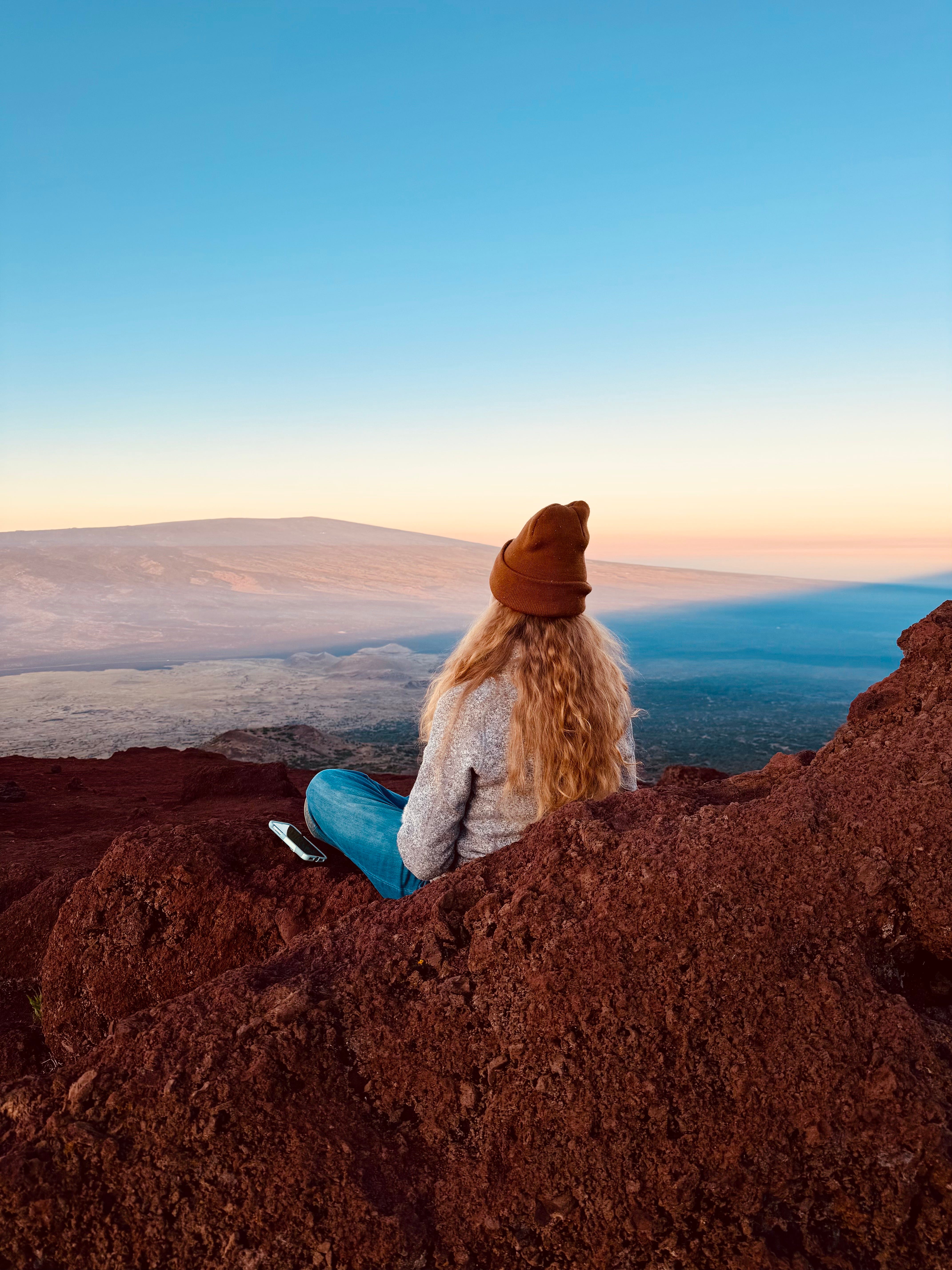
Trish led us in the Hawaiian chant E Hō Mai. Her voice rang like a bell through my body, the only sound, save for some occasional laughing birds across the road, for miles. We each took a place on boulders the color of red clay facing in different directions and sat in silence.
When I allowed the stillness to settle in me, tears came. I let them. There were no thoughts attached, no stories circulating or a defense of reasons from my swirling brain. Just an internal stirring and release.
I came in gratitude, and it was more than my body could contain. I said a silent prayer: Thank you to this land for holding me, for stretching me, for breaking me in all the ways I’ve needed. I came to this island with a plan and a vision for my life, and I could not have anticipated what transpired instead. Not what I wanted, but the medicine I needed to become more whole. Thank you.
After 15 minutes or so, we heard the crunch of approaching feet. A man’s voice broke the sound fast as he chanted in a foreign tongue his own prayer to the rising sun. Auspicious, indeed. We soaked it in and left shortly after what felt like a natural closing, thanking him for the blessing on the way out. He bowed in acknowledgment like a monk under a vow of silence.
We stopped by the ranger check point to receive instructions on how to ascend to the peak safely: Stay in 4WD Lo on the way up. Shift into 2nd or 3rd gear on the way down. Don’t ride the brakes. If you feel any symptoms of altitude sickness — headache, nausea, dizziness — head back down immediately.
The terrain was rough and looked like the surface of an abandoned moon. We off-roaded on an incline for 20 minutes before passing one or two other cars, apparently earlier birds than us who made it to the top for the sun’s grand entrance.
The peak of Mauna Kea is 13,803 feet above sea level, and it’s an alpine climate. More than half the year, there’s snow up there. But not that day. That day was crystal clear and silent and still. That day was a perfect first and last.
I got out of the car and immediately felt it. Not quite on the verge of passing out, but on the verge of the verge. “Oof. I feel a bit lightheaded,” I said to my friend Matia, who grew up on a farm and has all sorts of practical skills and knowledge, among them wilderness survival training. She asked if I felt nauseous too. “A little bit,” I responded, “but I can’t tell if it’s woke-up-at-3 a.m.-nausea, or altitude-sickness-nausea.”
“If you don’t feel better in about 4 minutes, we should head back down.” The specificity scared me. What would happen beyond 4 minutes? I nodded, heeding her warning and putting aside my inclination to tough it out so as not to ruin the experience for the others. I walked slowly towards the guardrails and tried to focus on the breathtaking scene before me, when suddenly my heart began pumping as if I was in the final yards of a cross country race and was giving it my all.
“Would you feel it in your heart, too?” I asked in a voice that came from me but felt like it was someone else’s. Matia stopped in her tracks and immediately checked my pulse as I dropped to my knees and laid face down, hugging the earth.
“Gang?” Matia called to the other two after 30 seconds or so, in that tone parents use when they’re trying to project calm in a stressful situation, “We need to head back down. Like now.”
My head still down, I focused on my breath. My body was freaking out, but I didn’t feel panicked. I was talking to it, trying to soothe it and sync whatever was happening mechanically with my still mind and this surreally still point in time and space. I’m fine, I’m fine, I’m fine, I repeated like a mantra.
“Can we take just one picture,” someone called from far away. “Yes, but just one,” Matia said sternly. “We need to hurry.” I loved her for this. I knew I was in capable hands and everything was going to be OK once we made it to less great heights. Matia hopped in the driver seat and I took shotgun. As we rounded the first switchback, I could feel my heart calming down and my mental facilities coming back online as we continued to descend.
We made it back down to the visitor’s center, where a ranger approached to check our brakes and gave us the all-clear. We made it. The car made it. All is well.
We took a short walk on a trail behind the visitor center to regain our (my) landlegs and to see the ‘ahinahina or silversword, a plant that grows only in this one specific location on the entire earth. In a place that’s inhospitable to most forms of life, it has adapted to the alpine climate with striking silvery hairs that reflect intense UV radiation and help it retain moisture. This mysterious plant can live for over 90 years, but blooms only once in its unusually long life and dies immediately upon disbursing its seeds, its final act a rebirth through the portal of an ending. One word came to mind: auspicious.
After spending the last 24 years adapting to other environments that I called home but where I felt like a stranger in a strange land, I am leaving this island and returning to the land that birthed me. After so much time on terra incognita, what will it feel like to close the loop on firsts and re-acclimate to the place I came from? Can I return to the soil where I was planted and trust that I’ll bloom? Can I trust that the sun will continue to rise and fall in its natural cycle no matter my GPS coordinates?
I think of the silversword, with its relentless adaptability. It has touched the sky and discovered what it means to be rooted. I think of the solstice and the never-ending game darkness and light play, taking turns chasing the horizon and each other, trading hours for seasons in a dance from solstice to equinox, solstice to equinox. I think of the first time I set foot on this island and who I was then, from the distant vantage point of who I am now. And I think of all the firsts in between that changed me along the way.
There is so much beauty hiding in lasts, it will move you to tears. It will throw you to your knees in gratitude. It will destroy you so that you can bloom into a shinier and hardier version of yourself, seeded with the grace to begin anew.
P.S. There’s a quiet tradition in many cultures of renaming oneself after a loss, a journey, or an otherwise profound shift. It’s a way of saying “I survived that crossing, but I’m not the same person who stood on the starting shore.”
With Aloha was the name for a period of my life that has now drawn to a close. It’s been a journey, to say the least, and to keep calling this space by that name would feel like pretending the shift didn't happen. So from now on, these postcards will arrive under a new name: Notes from the Deep Wild.
Nothing about how you access this space changes, and you don't need to re-subscribe. I’m simply letting the title reflect the quiet reality of this new landscape. Thank you for walking through this threshold with me, and beyond.
A rebirth through the portal of an ending like the Ahinahina... Truly auspicious! I'm inspired by your riveting storytelling and sending my love and best wishes for your new adventure, Rach! Warm aloha and love to you! Bets
Wow! And end of a chapter. I loved all your stories from Hawaii. 🌈